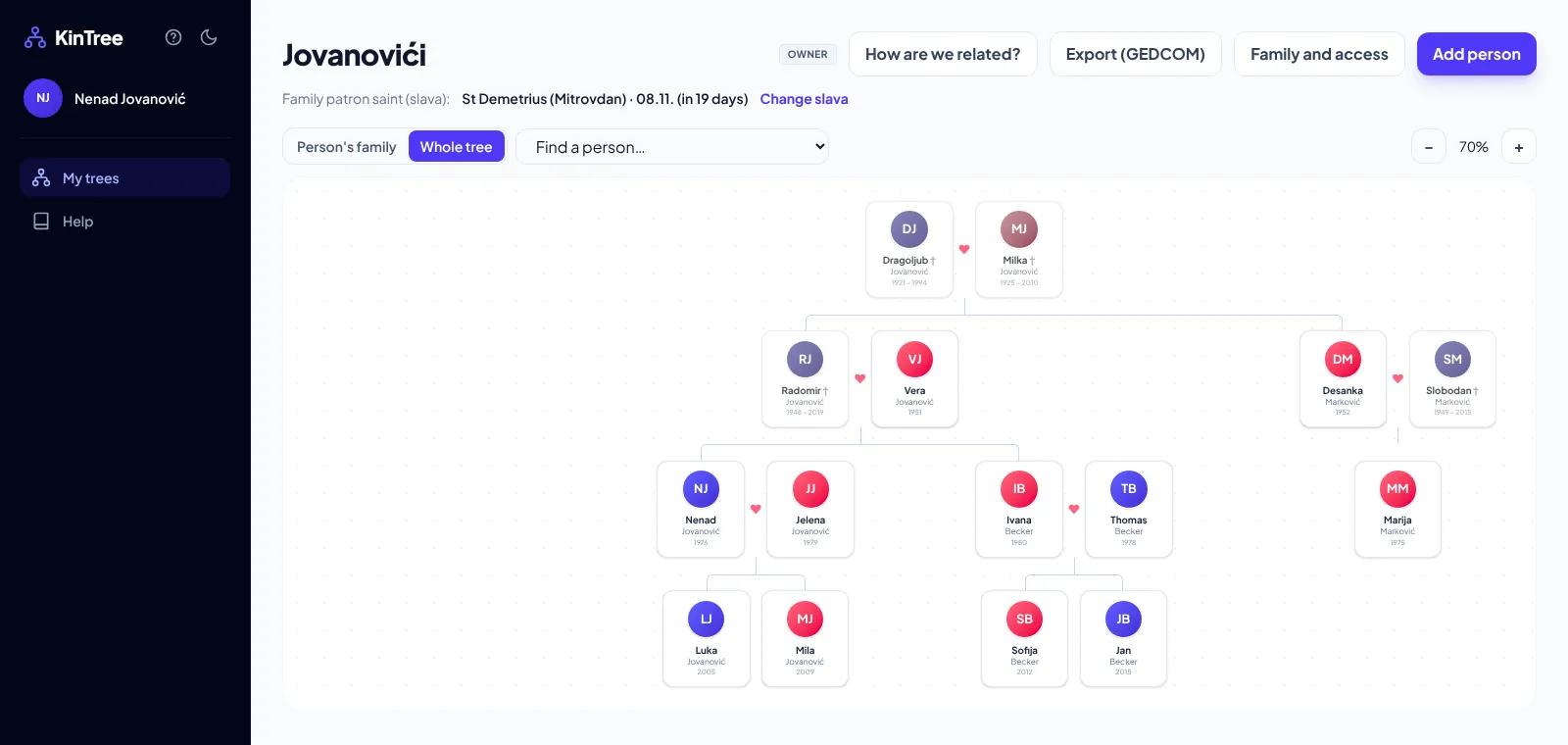
1. Start with yourself
Add yourself, then your parents and grandparents. A first and last name is enough for each person (for women also the maiden name); the rest you add when you find out.
If you don't know an exact date of birth, enter just the year, or the month and year. Old records often only know the year, and that is fine.
2. Ask the oldest people in the family
Grandparents know the most, and only while they are still with us. A few questions to start with:
- What were your parents' and grandparents' names? Where did they come from?
- How many brothers and sisters did you have, and where did they all go?
- Which slava did the family celebrate?
- Where and when did you marry, and who was your best man (kum)?
- Where are your parents buried?
Record the conversation on your phone and keep the recording in the person's archive. A grandmother's voice is worth as much as the facts.
3. Look for records and photos
Birth, marriage and death certificates, old photos with writing on the back, military papers and gravestones give you dates and places. In KinTree every person has an archive for photos, documents and audio.
You can also take a photo of a certificate or other document, and KinTree reads it and fills in the person's form. You check it and save. A free tree has five of these readings.
4. Invite your relatives
Send a link to your parents, siblings, aunts and cousins, wherever they live. Each one gets a role: a viewer looks and can suggest a change, an editor adds their own branch.
A relative who is already in the tree clicks “This is me” and their account is linked to them. Relatives never pay anything.
5. Keep it and share it
When the tree has grown, download it as a PDF and share it with relatives. You can always export the tree as a GEDCOM file, and the public link shows only deceased people, never the living.